Workflow Tax: Why Your Content Team Spends 60% of Time NOT on Content
Your tools work fine. The problem is what happens between them — and it's eating 60% of your team's time.


Key Takeaways
- The 60% problem is invisible. Knowledge workers spend six out of ten minutes on coordination — switching apps, searching for information, communicating about work — not doing the work itself.
- More tools made it worse. Martech usage dropped from 58% to 33% as the market grew to 15,384 tools. AI hasn't helped either — 47% of content teams report no speed gain.
- Integration is not orchestration. Syncing a field between your CRM and email tool is integration. Carrying a brief's intent and brand voice through every production stage is orchestration. Most stacks only do the first.
- Measure between tools, not inside them. Time-to-publish, from brief approval to live, is the single metric that captures the entire workflow tax.
Workflow Tax is the cumulative time and productivity lost to coordination, context-switching, and manual handoffs between disconnected tools in a content production pipeline. Research shows knowledge workers spend 60% of their time on this "work about work" — and adding AI creation tools has not reduced it, with 47% of content teams reporting no speed gain from AI adoption.
Watch the Episode
This article is the companion piece to Episode 3 of our Weeks to Hours Transformation Series — a live webinar series exploring how content teams are compressing production timelines with AI without losing what makes their work effective. Below is the full recording, followed by the expanded argument with sources and context that a live session can't fully cover.
Want the slides? The full presentation deck from this episode is available to browse or reference alongside the recording.
Fifteen thousand, three hundred and eighty-four. That's how many marketing technology tools exist today — a 100x increase since Scott Brinker started tracking the market in 2011. Your team probably runs twelve to twenty of them. CMS. DAM. Project management. AI writing assistant. Review platform. Maybe two review platforms because the first one didn't stick.
And 62.1% of companies added tools in the last two years. The pitch was always the same: this will make your team faster.
So — did it?
The Line Goes the Wrong Way
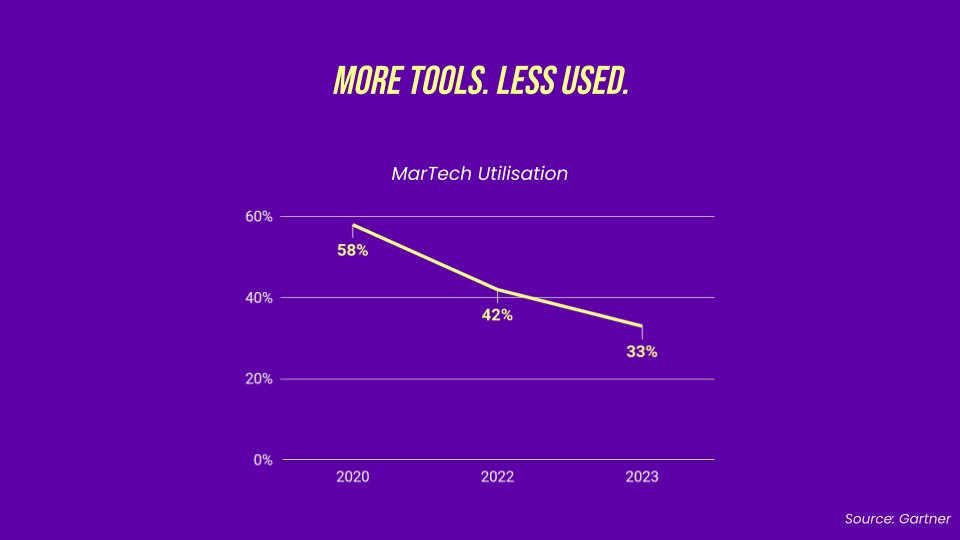
Gartner tracks how much of the marketing tech stack companies actually put to work. In 2020, it was 58%. By 2022, it had dropped to 42%. The most recent number? 33%. You're using a third of what you're paying for. More tools, less capability used. The line goes the wrong way.
And yet — 96% of marketers describe their tech stack as "successful". While barely half the tools they're paying for are actually being used. Same pattern we saw in Episode 2 — 80% think they write good briefs, 10% of the people working from those briefs agree.
of your martech stack's capability is actually used, according to Gartner — down from 58% three years ago. More tools, less value extracted.
So where is the time going?
Six Out of Ten Minutes
Knowledge workers spend 60% of their time on "work about work". Not creating or designing. Communicating about work, hunting for information, switching between apps. Six out of every ten minutes.
Run the maths. Ten people, 60% overhead — that's six full-time equivalents doing nothing but coordination. Not because they're inefficient. Because the system demands it.
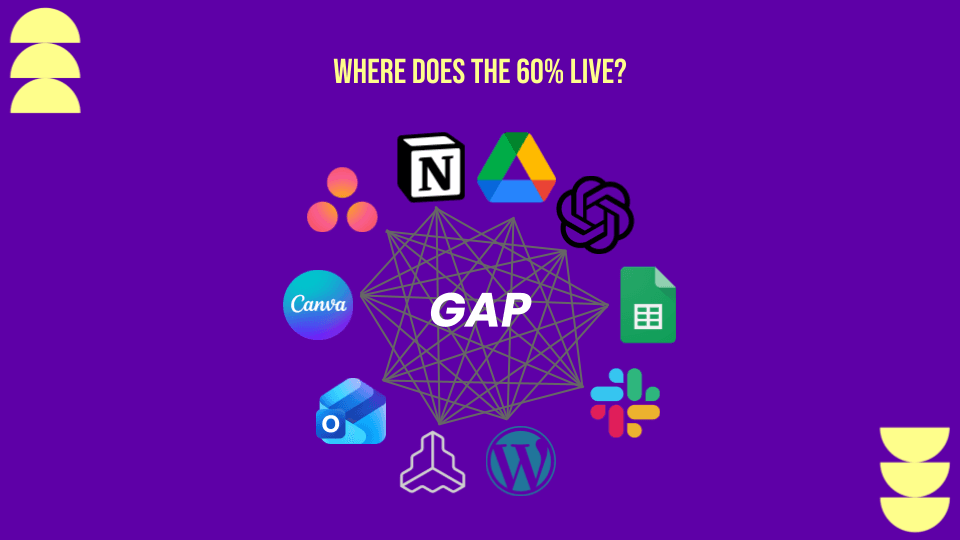
That 60% doesn't live inside any tool. There's no "coordination overhead" report in your CMS. No "context loss" metric in your project management tool. It lives in the spaces between tools — the Slack threads asking "can someone send me the latest?" and the status meetings that exist because no system can answer: where is this piece right now?
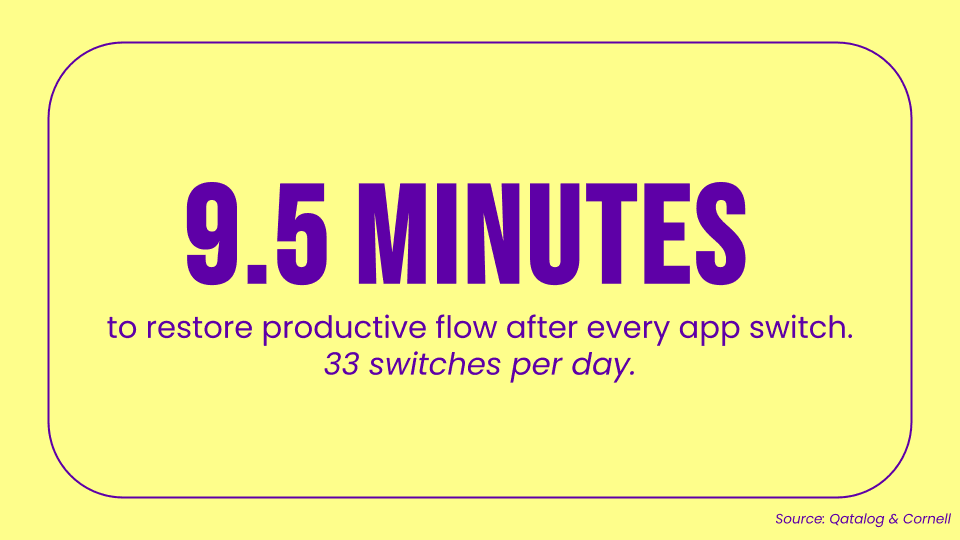
And every one of those moments has a cost. Qatalog and Cornell University's Ellis Idea Lab found it takes nine and a half minutes to restore productive flow after switching apps. Not seconds. Minutes. Your team switches apps roughly 33 times a day. So every "has anyone seen the updated brief?" in Slack isn't a ten-second interruption — it's a ten-minute recovery cycle for everyone who reads it.
"The real cost of your software stack isn't what shows up on your monthly SaaS bill. It's what happens in the gaps between your tools."
— Ellis Talton, SVP GTM at Briq (source)
AI Made the Problem Visible
You might be thinking: OK, but AI is fixing this. 90.3% of marketing teams now use AI agents somewhere in their stack.
But the data should give you pause. Only 49% of content professionals say AI actually makes them faster. The other 47% report no change or slower production. Nearly half.
AI generates content quickly. But if the workflow between brief and draft and review and publish is broken, all AI does is produce content faster that still takes two weeks to ship.
Faster creation hitting a disconnected workflow is like pouring water faster into a leaking pipe — more volume, same result at the other end.
The Tax Lives Between Your Tools
Your CMS, your AI writing assistant, your project management tool — each one works. The problem is the tax you pay in the spaces between them. The context that evaporates at every handoff. The tribal knowledge that became the integration layer nobody budgeted for.
That's the workflow tax. Every new tool creates a gap that a person ends up filling.
Most content teams are stuck in operations — managing twelve tools well in isolation, while the workflow between them runs on Slack and institutional memory.
"Content operations is everyone following their own playbook. Content orchestration is everyone following the same playbook."
— Cathy McKnight, Content Marketing Institute (source)
Think about a relay race. Four world-class sprinters. Each one can run their leg in under ten seconds. But the race still comes down to the handoff zone. Drop the baton, and it doesn't matter how fast anyone ran.
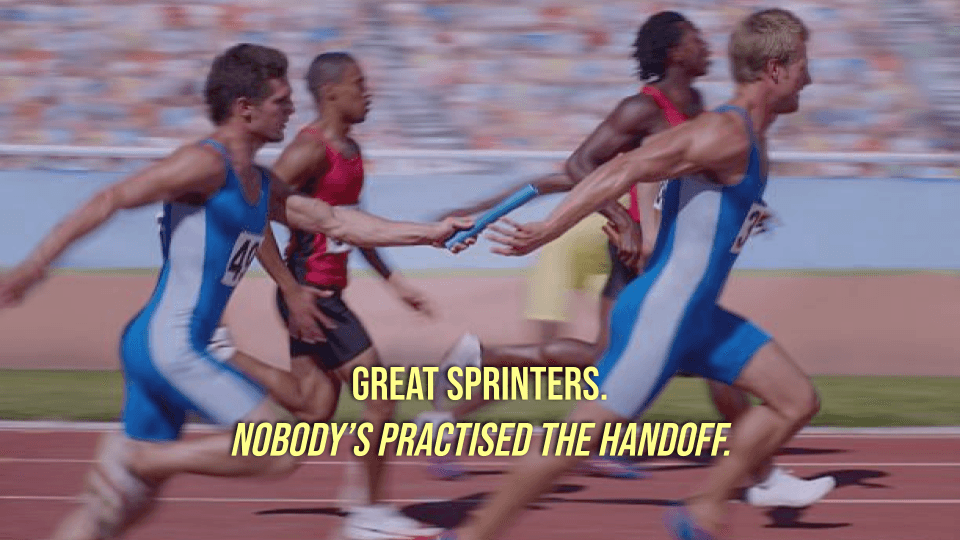
The baton is context, and the handoff zone is the space between your tools. You've hired great sprinters and given them great shoes — but nobody's practised the handoff.
Scott Brinker asks: "Will there be one conductor that sees across the entire orchestra?" Right now, in most content teams, there is no conductor. Every instrument plays well, but nobody's reading from the same score.
From Tool Reviews to Connection Audits
Once you stop looking at individual tools and start looking at the workflow between them, three things follow.
1. Evaluate connections before evaluating new tools
You're using a third of what you already have. Extract that value before adding more. The next dollar should go to connecting your stack, not expanding it.
2. Start measuring what happens between tools
Time-to-publish, from brief approval to live. Handoff delays. Context re-entry — how often someone has to re-explain something the system should already know. These are the metrics that reveal the tax.
Plug in your team size, tool count, and coordination hours to see exactly how many FTE-equivalents and dollars you're losing to the spaces between your tools.
3. Run the onboarding test
If a new person joins your team and can't figure out the workflow from the system itself — if they need a veteran to explain "how things actually work here" — your workflow isn't connected. The system should teach the process, not the people.
In disconnected content operations, new team members don't just learn the tools — they learn the unwritten rules that govern how information moves between them. Which Slack channel holds which decisions. Whose sign-off actually matters versus what the process doc says. Where the "real" latest version lives. That tribal knowledge is the real integration layer, and it doesn't scale.
The Asset's Journey: Before and After
Let me make this concrete.
A content team. Good tools, good people. Producing a campaign landing page.
The brief gets written in the project management tool. Target audience, brand voice, success criteria — all there.
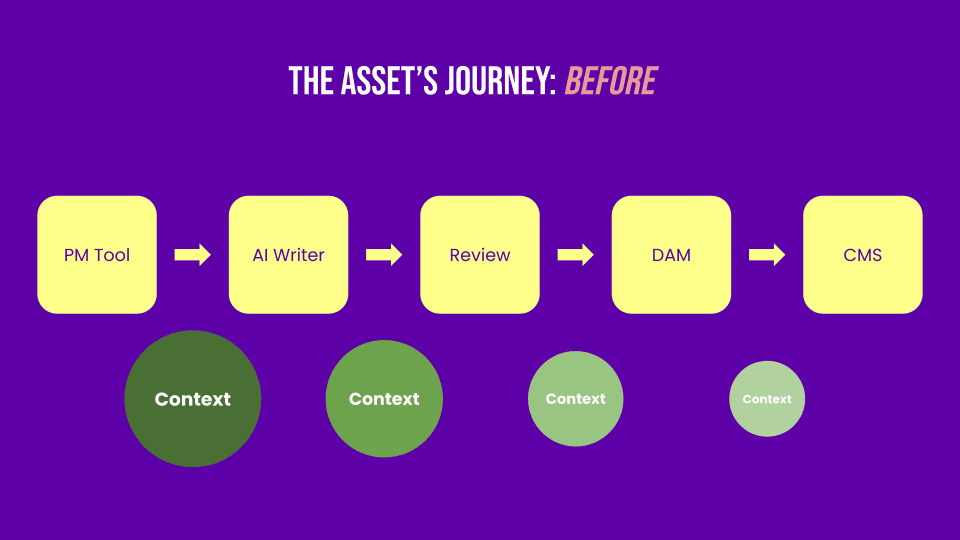
The writer opens the AI writing assistant, pastes in the brief, gets a draft in minutes. Fast. But which brand voice guidelines did the AI use? Last quarter's refresh, or the ones before? Did the writer include the messaging hierarchy, or just the brief text? Some context made the trip, and some didn't.
Draft goes to review. The reviewer doesn't have the original brief side by side. Reviews against their own understanding of what was wanted — not what was specified. "Can someone send me the latest?"
Two review cycles later, it ships. But does it match the success criteria from the original brief? Nobody checks — because the brief is three tools and two weeks ago.
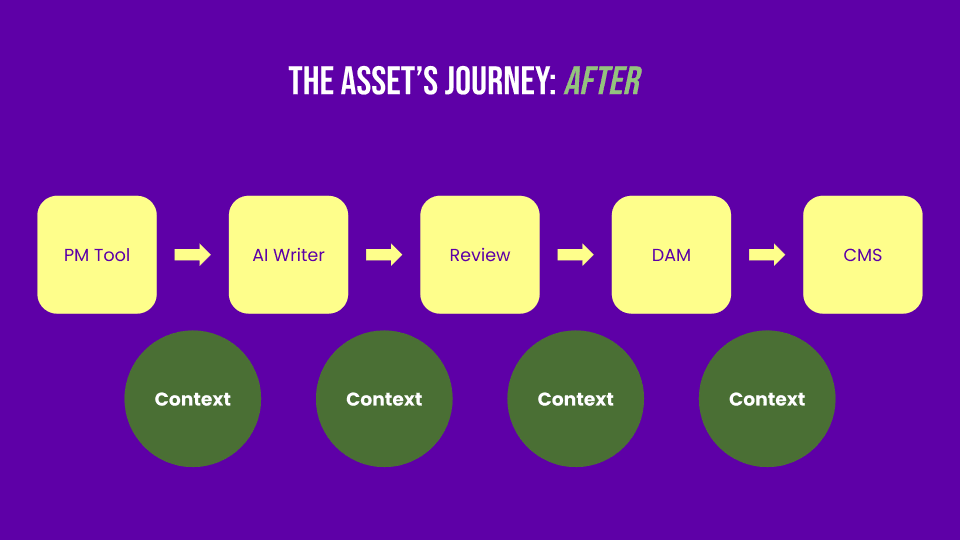
Now. Same team, same tools, but with an orchestration layer connecting them. The brief's context — audience, voice, success criteria — flows into the draft automatically. The review stage references the brief's criteria directly. One version, one place to look. "Where is this piece?" answered by the system, not by Slack.
They didn't purchase new tools or hire anyone. The only change was whether context survived the journey — or evaporated at every handoff.
We'll walk your content pipeline end to end — from brief to publish — and show you exactly where context is leaking, which handoffs cost you the most, and what changes when the workflow is connected instead of cobbled together.
Two Paths to Connected Operations
There are two ways to get there.
The DIY path: vibe-code it yourself. Any marketer who's comfortable with Claude Code or similar tools can wire Notion to an AI drafting layer, route reviews through Slack, push to the CMS. It works. But these systems grow. You add a rule, a trigger, another integration. And when something breaks — an API change, a bug, a routing conflict — the marketing team can't fix it. It sits broken until an engineer has time. You've traded one gap for another.
The done-for-you path: this is what we've been building with Protaigé. After thousands of production cycles, I kept seeing the same thing: great inputs going in, context disappearing between stages. The Brand DNA work from Episode 1 fixes the voice. The Brief Builder from Episode 2 fixes the target. But if context evaporates between tools, you've fixed the inputs and lost the value in transit.
What I've learned: when the brief's intent travels with the content through every stage, revision cycles collapse. Not because any single tool got faster. Because the gaps disappeared.
Three Things You Can Do This Week
Count your tools
Not just the ones you pay for — include Slack, email, shared drives, the spreadsheets that track what no tool tracks. Every item on the list that doesn't talk to the others is a gap filled by a person.
Run the handoff audit
Pick one piece of content from last month. Trace its journey from brief to publish. At every handoff between tools: did the context travel, or did someone re-enter it?
Measure time-to-publish
From brief approval to live. Track it for two weeks. That single number tells you more about your workflow tax than any tool dashboard ever will.

Michael has spent nearly three decades inside the production ecosystems Protaigé is disrupting. As Chief Delivery and Studios Officer at Ogilvy, Regional CEO APAC & MEA at Publicis Production & Prodigious, and Regional CEO APAC for Ogilvy RedWorks, he's led the teams that global brands pay to hold their marketing intelligence - and watched that intelligence stay trapped in agency relationships, scattered across markets, and rebuilt from scratch with every new engagement.
CONTINUE READING

Got Brief? The Best Marketers Don't Write Better Prompts — They Write Better Briefs
80% of marketers think their briefs are good. Only 10% of agencies agree. That gap is where your revision cycles live.
 Chrissy Lim
Brand Voice Gap: Why Your AI Content Sounds Like Everyone Else's
AI writes generic content because you haven't given it your brand. Fix the input, and the output fixes itself.
 Wawa Gilewski