Brand Voice Gap: Why Your AI Content Sounds Like Everyone Else's
AI writes generic content because you haven't given it your brand. Fix the input, and the output fixes itself.


Key Takeaways
- Generic AI content is an input problem, not an output problem — fix what you feed AI, and the output fixes itself
- Teams lose 390 hours a year to repetitive voice editing that never compounds into improvement
- Consistent brands grow at roughly 2.4x the rate of inconsistent ones — brand inconsistency is a revenue problem
- 95% of organisations have brand guidelines, but only ~25% enforce them and ~31% have guidelines designed for AI
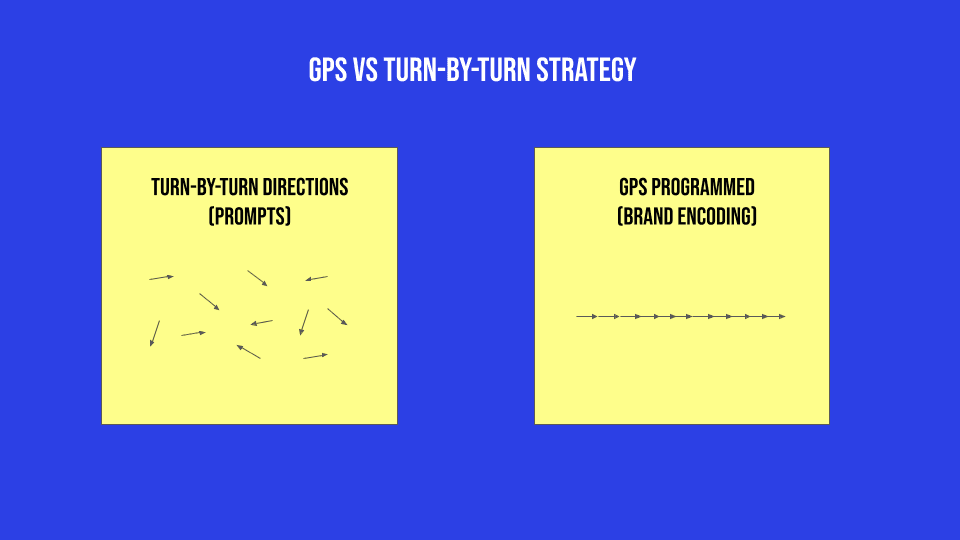
- Prompts are turn-by-turn directions; brand encoding is programming the GPS
Brand Voice Gap is the disconnect between what a company's brand sounds like in human-written content and what its AI-generated content produces — caused by organisations failing to encode their brand voice in a format AI tools can use. The result: generic, interchangeable output that costs teams an estimated 390 hours per year in manual voice editing.
Watch the Episode
This article is the companion piece to Episode 1 of our Weeks to Hours Transformation Series — a live webinar series where we break down the systems, data, and strategies behind scaling content with AI without losing what makes your brand yours. Below is the full recording, followed by the expanded argument with sources and context that a live session can't fully cover.
Want the slides? The full presentation deck from this episode is available to browse or reference alongside the recording.
The Ghostwriter You Never Onboarded
You hire a ghostwriter. She's fast — a polished thousand-word article in three minutes flat. But she's never read a single thing your company has published. Doesn't know your industry. Doesn't know your quirks. She's fast, so you hand her the assignment anyway.
The draft arrives in minutes. It's... fine. Grammatically correct. Facts check out. But it sounds nothing like you. It could belong to anyone in your space. So you spend 45 minutes making it sound like yours.
Next week, same story. Same ghostwriter. Same generic draft. Same 45 minutes fixing it. And the week after that. She never gets better, because you never showed her what your brand sounds like. You just keep handing her assignments and cleaning up after.
That ghostwriter? She's what most of us are doing with AI right now.
We All Bought the Same Promise
Everyone reading this made the same bet. You invested in AI to produce more content, faster, without proportionally growing your team. And on the surface, it paid off. Drafts that used to take a day started arriving in minutes. Volume went up.
You weren't alone. 85% of marketers now use AI writing tools. 80% of content teams use AI for draft creation or ideation. This isn't early-adopter territory anymore. It's the industry default.
But something else happened alongside the volume increase, and you've probably seen it. The drafts come back fast, but they sound generic and interchangeable. Your audience can't tell the difference between your AI blog post and your competitor's. The content is grammatically correct, factually adequate, and completely without personality.
So your team does what every team does. They edit. Rewrite. Paste style guides into prompts. Add tone instructions. Some teams have added entirely new roles (prompt engineers, content editors whose only job is "making AI sound like us"). 48% of companies are now adding AI-specific roles to manage the human-AI workflow.
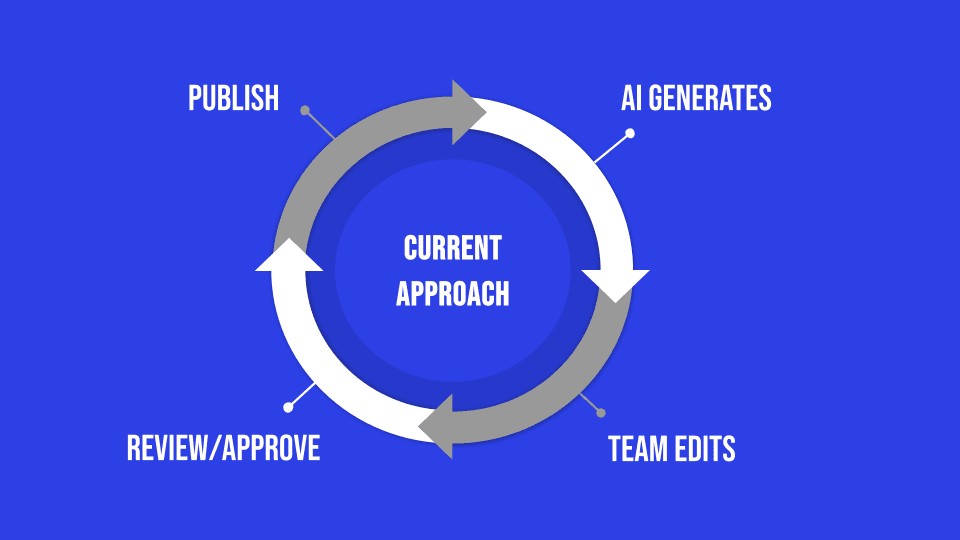
Smart workarounds, all of them. But is the problem getting better?
The Editing Treadmill
It isn't. The numbers back this up.
37% of teams say their review and approval process is resource-heavy. That's more than a third of content organisations where the editing layer has become the bottleneck — not the solution. And 60% of marketers using AI are concerned it could harm their brand's reputation. A real, widespread concern about what AI-generated content is doing to brand equity.
We adopted AI to go faster. Then built an editing layer to slow it back down. That's the editing treadmill — constant effort that never compounds.
The math makes it personal. Say your team edits ten AI-generated pieces a week. Each one takes 45 minutes of voice editing. That's 7.5 hours a week. Nearly a full workday. Every single week.
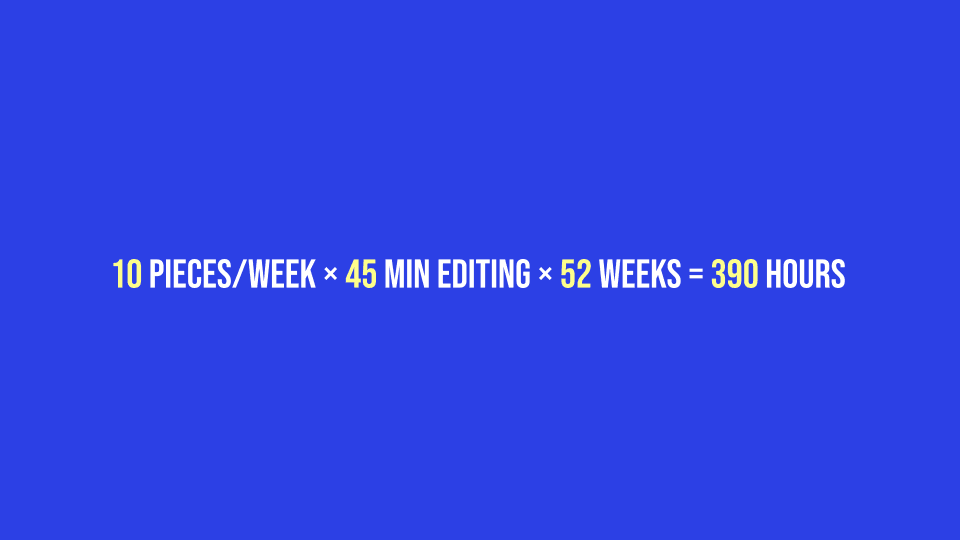
What would your team do with 390 hours back?
The cost goes beyond efficiency — it shows up in revenue. In Lucidpress's 2021 Content Effectiveness Report, 68% of companies reported 10–20% revenue growth after implementing brand consistency initiatives. Consistent brands grow at approximately 2.4x the rate of inconsistent ones. And 81% of consumers say trust is a deal breaker or deciding factor before they'll buy.
Every off-brand piece erodes that trust. The longer you scale AI content without fixing this, the harder the fix becomes. Coordination costs grow combinatorially as teams scale — five writers means ten pairwise paths for voice to drift. Fifty writers means over a thousand. This is Frederick Brooks's observation from The Mythical Man-Month, and it applies directly: adding more people (or more AI output) to a process without a shared system makes the consistency problem worse, not better.
revenue growth reported by 68% of companies after implementing brand consistency — and that was before the AI content explosion.
Score your AI-generated content against the patterns that give it away. Pull up 3–5 recent pieces and audit them in minutes — paste the checklist into any AI tool and let it catch its own tells.
The Real Problem Is Upstream
Most teams haven't looked in the right place. The root cause isn't where they've been trying to fix it.
AI writes generic content for one reason: nobody told it to do anything else.
Without your vocabulary, sentence rhythm, or rhetorical patterns, AI defaults to the statistical average of its training data. Ethan Mollick, the Wharton professor who wrote Co-Intelligence, compares it to onboarding an intern without telling them anything about the company. You wouldn't expect a new hire to nail your brand voice on day one with zero context. Why do we expect that from AI?
The gap becomes undeniable when you look at the data. 95% of organisations have brand guidelines of some kind. Only about 25% actively enforce them. Only about 31% have guidelines designed for AI content creation. And just roughly 12% have formal, dedicated AI governance frameworks.
Most of you have guidelines. They just weren't built for AI.
Find out whether your brand documentation gives AI enough to work with — or whether it's leaving AI to guess.
Your brand voice lives as tribal knowledge in the heads of two or three senior writers. That worked when humans wrote everything. It doesn't work when AI produces ten times the volume.
Robert Rose at the Content Marketing Institute has been making this argument for years — most thoroughly in his book Content Marketing Strategy: Harness the Power of Your Brand's Voice (Robert Rose, Kogan Page, 2023). His position is that most organisations never properly documented their brand voice in a way that's usable beyond a few senior people's heads. AI just made that gap impossible to ignore.
Fix the input, and the output fixes itself.
The distinction that separates this argument from the "write better prompts" advice saturating the market: prompts are turn-by-turn directions to one destination. Brand encoding is programming the GPS for every trip. One is per-piece and fragile — fifty people writing their own prompts means fifty different versions of your brand voice. The other is persistent, shared, and it compounds over time.
There's a principle from manufacturing that maps directly onto this. W. Edwards Deming proved that you can't inspect quality into a product. Factories spent decades adding more inspectors at the end of the production line. It never worked. Quality had to be built into the inputs, the systems, the standards. Every industry that scaled successfully learned this, and content operations is no exception.
Editing AI output for brand voice is end-of-line inspection. It's expensive, it's inconsistent across editors, and it doesn't scale. The fix is upstream.
What Changes When You Fix the Input
When brand voice moves from the editing stage to the input layer, the dynamics shift.
When AI starts from structured brand voice data, the first draft is already more on-brand. The 390 hours shrink. The time goes back to strategy, creative work, and distribution.
Consistency becomes a system, not a bottleneck. Think McDonald's: 40,000+ restaurants across 100+ countries, maintaining recognisable consistency through codified operations manuals, not individual talent. Your brand guidelines need to work the same way — encoded knowledge that every tool and every team member draws from automatically, without interpretation.
The drift reverses, too. Instead of off-brand content begetting more off-brand content, encoded brand voice becomes the baseline everything builds on. New hires onboard faster, agency partners match your voice from the first draft, and the system gets better over time instead of drifting further from the standard.
The 25–35% productivity gains teams report from AI? Those become real — not theoretical numbers that vanish once you factor in the editing tax: 51% of marketers say they can't measure AI ROI at all. Fix the input, and the output becomes measurably better.
Doug Kessler at Velocity Partners has spent a decade arguing that B2B content drowns in undifferentiated sameness. His "Crap" presentation made the case long before AI accelerated the convergence. The teams that encode their voice don't just avoid the bland middle. They stand out against it — because when everyone's AI produces the same statistical average, the brands with encoded voice are the ones readers can still name after closing the tab.
Kessler's body of work — from his viral "Crap" presentation to his writing on tone of voice as competitive advantage — makes the case that genuine, codified brand voice is the antidote to content homogeneity.
| Before (The Editing Treadmill) | After (Encoded Brand Voice) |
|---|---|
| Draft in 3 minutes. 45 minutes making it sound like you. Tomorrow, same thing. AI never learns. | Draft lands on-brand, the team reviews in ten minutes, and each piece trains the system to get closer next time. |
| Voice lives in two senior writers' heads. When they're on holiday, quality drops. | Voice is encoded once and inherited everywhere — across people, tools, and channels. |
| 390 hours a year on repetitive editing that never compounds. | That time goes back to the work your team was actually hired for. |
| ~55% of customers feel like they're talking to separate departments. | One voice across every touchpoint. Customers experience one company, not a collection of teams. |
How to Encode Your Brand for AI
Your brand guidelines already have the raw material — they just need restructuring for machines instead of humans.
Most brand guidelines stop at adjectives — "confident, approachable, innovative." AI-ready encoding goes deeper: vocabulary patterns, sentence structures, audience assumptions, and tone calibration by content type. The gap between what most guidelines contain and what AI actually needs is where generic content comes from.
Two valid paths from the same insight:
Path one: do it yourself. Audit your existing brand voice documentation against AI-readiness criteria. Restructure it into a format AI tools can use — not adjectives, but specific, granular instructions covering vocabulary, rhythm, perspective, and structure. Configure your AI tools with this structured input. Build governance around it. It works. It takes dedicated time and ongoing attention.
Build your brand voice reference once, then get on-brand AI output every time — before you edit a word.
Don't have brand guidelines to restructure? Protaigé's Brand Helix is a free tool that generates brand guidelines from scratch — no account required. Start there, then use the setup guide above to make what it produces AI-ready.
Path two: done-for-you. Protaigé's Brand DNA capability ingests your existing documentation — guidelines, tone of voice, personas, visual identity, the assets you already have — and encodes them into an AI-ready foundation applied across every piece of content. The system applies your encoded voice at every stage of production — from brief to final copy — using specialized agents for strategy, creative direction, writing, and brand review.
Both paths start from what you already have. Neither requires you to build a brand voice from scratch.
Three Things You Can Do This Week
Run a voice audit
Score your last ten AI-generated pieces against your brand guidelines. Where do the same gaps keep appearing? Those gaps are what's missing from AI's input.
Document what's in your head
Get your best writers together for an hour. The words they'd never use, structures that feel right, tone shifts between content types. Write it down in specifics, not adjectives.
Test the difference
Prompt AI with just a topic. Then prompt it again with structured brand context — vocabulary, audience, tone specifics. Compare the two outputs. You'll see the difference in seconds.
We all want to scale content with AI. Brand voice can't be something we fix after the draft is done. It has to come first — before the workflow, before the first draft.
Remember that ghostwriter? The one who was incredibly fast but never learned your brand? She's still waiting. She just needs you to finally show her what your brand sounds like.
Generic AI content traces back to what you feed it. Fix that, and the output fixes itself.

Wawa has a decade of consulting and process optimisation experience - from Deloitte CEE strategy to in-house process improvement roles, to founding one of Poland's first virtual assistance networks, to running his own market intelligence consultancy across 14+ industries including financial services, transport, telecom, and healthcare. He's mapped go-to-market workflows, optimised time-to-market processes, and aligned sales operations with strategic goals - the same systematic thinking now applied to marketing process transformation.
CONTINUE READING

Workflow Tax: Why Your Content Team Spends 60% of Time NOT on Content
Your tools work fine. The problem is what happens between them — and it's eating 60% of your team's time.
 Michael Burgess
Got Brief? The Best Marketers Don't Write Better Prompts — They Write Better Briefs
80% of marketers think their briefs are good. Only 10% of agencies agree. That gap is where your revision cycles live.
 Chrissy Lim