Got Brief? The Best Marketers Don't Write Better Prompts — They Write Better Briefs
80% of marketers think their briefs are good. Only 10% of agencies agree. That gap is where your revision cycles live.


Key Takeaways
- Your revision problem starts at the brief, not at the review stage — 60% of marketers use the creative process itself to clarify strategy
- The perception gap is real: 80% of marketers rate their own briefs as good, but only 10% of agencies agree — and 74% of the brief writers are senior leaders
- BetterBriefs estimates 33% of marketing spend is wasted on misdirected work from poor briefs
- "Promote milk" gives you nice-farmer ads. A genuine insight gives you Got Milk? — the difference is whether the brief illuminates a human tension or just describes a deliverable
- AI makes this worse and better simultaneously: feed it a task brief and you get confident mediocrity at scale; feed it insight and it finds angles you hadn't considered
Briefing Perception Gap is the documented disconnect between how marketers rate their own creative briefs and how agencies rate the same briefs — 80% of marketers say their briefs are good, while only 10% of agencies agree. This gap, identified by the BetterBriefs Project across 1,700+ professionals in 70 countries, accounts for an estimated 33% of wasted marketing spend.
Watch the Episode
This article is the companion piece to Episode 2 of our Weeks to Hours Transformation Series — a live webinar series where we break down the systems and strategies behind scaling content with AI without losing what makes your brand yours. Below is the full recording, followed by the expanded argument with sources and context that a live session can't fully cover.
Want the slides? The full presentation deck from this episode is available to browse or reference alongside the recording.
Your team just published a blog post. It took four rounds of revisions, two escalations to the brand manager, a complete rewrite of the introduction, and a debate about whether the CTA matched the campaign objective. The final version barely resembles the first draft.
You know what happened next. Someone suggested adding an approval gate. Someone else created a feedback template. Maybe you hired another editor. And the next blog post? Same story. Different Tuesday.
After twenty-five years on the agency side — first as a suit, then as a creative and producer, then running my own agency — I've seen the whole spectrum. I've been blessed with some truly great clients and produced campaigns for Adobe, SAP, and Coca-Cola. But even I have been on the receiving end of some spectacularly dodgy briefs.
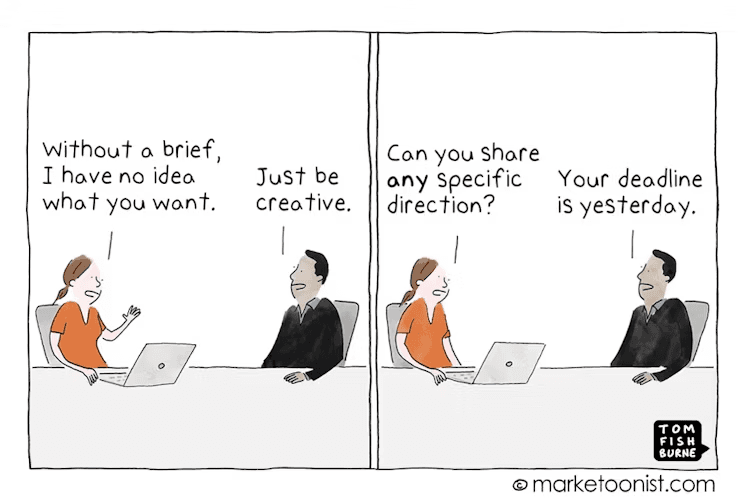
My personal classic: in the early days of social media, a client sent over a brief that read, in its entirety, "Make me a viral post." When we asked for a little more detail, the follow-up email contained one word: ASAP. True story.
I can tell you the brief is where this falls apart — every time. And the data on how deep that problem runs is, frankly, uncomfortable.
The Perception Gap Nobody Talks About
The BetterBriefs Project is the largest global study ever conducted on marketing briefs — over 1,700 marketers and agency professionals across 70 countries. The headline findings are hard to argue with:
of marketers think they write good briefs — but only 10% of agencies agree.
That's not a small miscalibration. Drill deeper: 78% of marketers believe their briefs provide clear strategic direction. Only 5% of agencies agree. 83% think they use clear, concise language. 7% of agencies agree.
And before you think "well, that's a junior-staff problem" — it isn't. The BetterBriefs study found that 74% of the people writing these briefs are over 35, 72% have more than 10 years' experience, and 64% carry the title of senior or director. The training-gap explanation doesn't hold. This is a systemic blind spot at the leadership level.
Marketing professor Mark Ritson, who co-authored the BetterBriefs/IPA best practice guide (downloaded by over 100,000 marketers), called the data "the most scary and remarkable bit of data I've ever seen." His diagnosis: "bad briefs are a key issue for marketers, it's that marketers don't think they are a key issue."
Every Revision Cycle Is a Strategy Conversation in Disguise
One stat should change how you think about your entire content workflow: 60% of marketers admit to using the creative process itself to clarify the strategy.
Read that again. The majority aren't defining what they want in the brief. They're using draft iterations to figure it out. That "round three feedback" where the stakeholder says "actually, I think we should target a different audience"? The strategy conversation that should have happened before the first word was written is happening in round three instead.
When a brief says "write a blog post about our new product for the website" and nothing else, every person in the production chain fills in the gaps with their own assumptions. The writer pictures one audience. The reviewer has a different picture. The stakeholder had a third in mind all along. Three rounds in, the team is negotiating what the content should have been rather than making it better.
"A brief from a marketer to an agency has one audience — the agency."
— Mark Pollard, Strategy Consultant (source)
of marketing budgets wasted on misdirected work from poor briefs — roughly $200 billion at 2021 levels, now projected at $429 billion.
The cost of this? 33% of marketing budgets wasted on misdirected work. At 2021 global ad spend levels, that was roughly $200 billion. BetterBriefs now projects the figure at closer to $429 billion. Janet Hull OBE, IPA Director of Marketing Strategy, put it simply: "A bad brief results in wasted time, money and patience all round." The patience part is the hidden cost. When creators are rewriting to hit a target nobody articulated, people start avoiding the process. When stakeholders feel "simple" requests take weeks, they stop trusting the team to deliver.
The Difference Between a Task Brief and an Insight Brief
So what does a good brief actually look like? This is where people go wrong. They hear "write a better brief" and think: more fields, more detail, more checkboxes, more success criteria.
That's a fine way to spec software. It's a terrible way to inspire creative work.
A good brief illuminates the problem — for the creatives doing the work and for the human on the other end who will see the ad, read the blog, or open the email.
The Nice-Farmer Problem
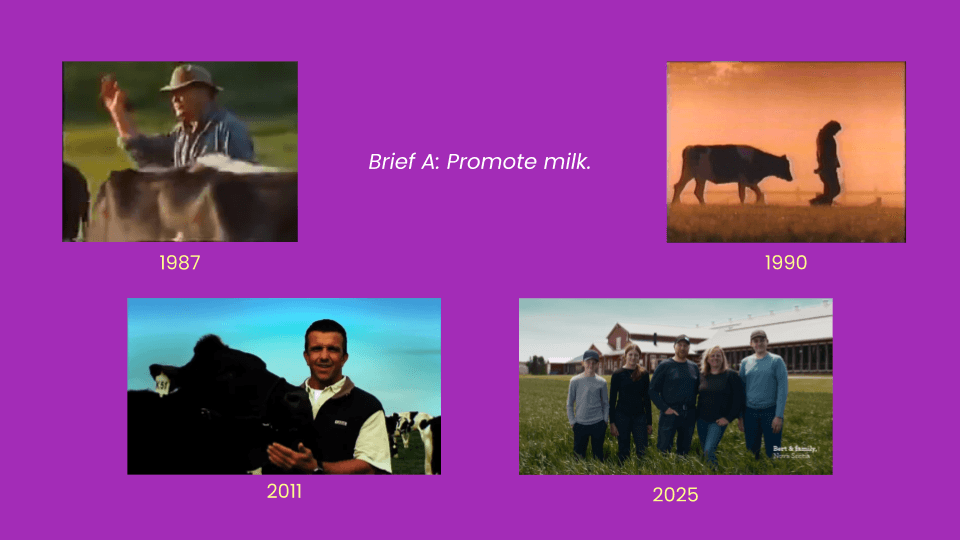
For decades, the dairy industry ran campaign after campaign showing happy cows, rolling pastures, and friendly farmers. The campaigns were beautifully produced. You couldn't fault the execution.
Meanwhile, consumers were switching to oat milk and almond milk. Every year, less cow's milk sold. Because "the farmer seems nice" isn't a reason to drink milk. The brief said "promote milk." It never asked why people were leaving.
Got Milk?
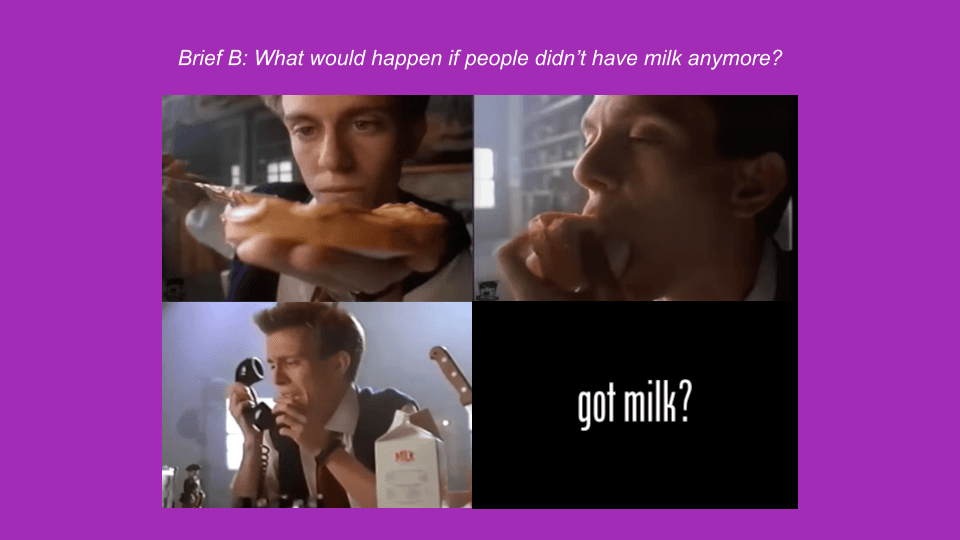
In California, milk consumption had also been declining for over a decade. Previous campaigns had used "Milk Does a Body Good" — a health message, because the brief was "tell people milk is good for them." Consumers already knew that. They just didn't care.
Then Jon Steel, partner at Goodby, Silverstein & Partners, did something different. Instead of asking "how do we get people to drink more milk?" he asked: "What would happen if people didn't have milk anymore?"
He recruited a focus group and paid them to give up milk for a week. When they came back, the stories were vivid. One man described coming downstairs before work, pouring cereal, slicing bananas on top — then remembering he didn't have milk. A woman said: "You don't really notice milk until it's gone."
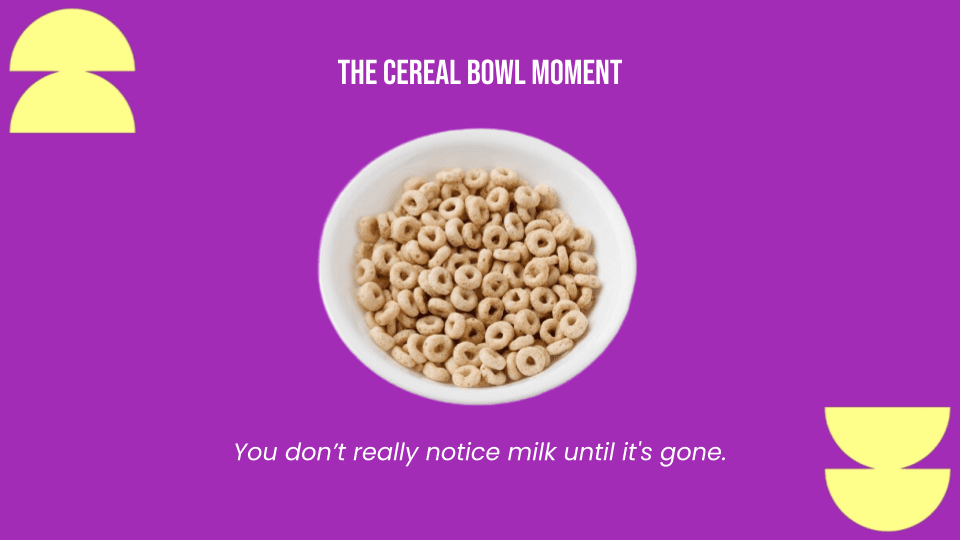
That became the insight. Not "promote milk." Not "communicate health benefits." A human truth: the quiet panic of reaching for something that's always been there but isn't anymore.
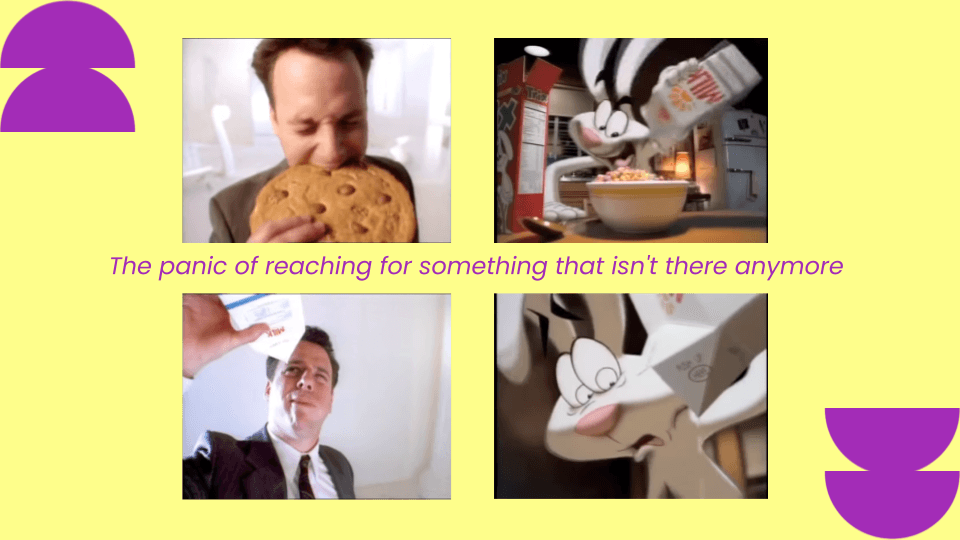
Steel flipped the entire strategy. Stop chasing non-drinkers. Target the 70% who already love milk and remind them of life without. The result was "Got Milk?" — the only dairy campaign globally that actually reversed the consumption decline. California milk sales went up for the first time in over a decade.
Same product. Same category. Completely different brief.
"If the creative brief is not itself creative, what right do its authors have to expect anything different?"
— Pat Fallon, Fallon Agency founder (source)
"Promote milk" gives you nice-farmer ads. "People feel genuine distress without milk at key food moments" gives you Got Milk? The brief didn't specify the output. It illuminated a tension — and then trusted the creatives to do something with it.
Lance Saunders, strategic consultant and professor at York University, calls this the misidentified-problem problem. A quote widely attributed to Einstein captures the idea: "If I had an hour to solve a problem, I'd spend 55 minutes thinking about the problem and 5 minutes on solutions." When briefs skip problem definition, the entire production process becomes that 55-minute exercise — except it's happening through expensive draft iterations instead of upfront thinking.
Now Give That Brief to AI
That 80/10 perception gap was a problem when humans were the only ones working from those briefs. Humans can push back. They can ask clarifying questions. They can walk over to your desk and say "what did you actually mean by this?"
AI doesn't do any of that. AI takes your brief at face value — every word you wrote and every assumption you didn't spell out. If the brief says "write a blog post about our new product," AI will write a blog post about your new product. It'll be competent, grammatically correct, and completely generic.
A human given that brief produces mediocre work after five rounds of "is this what you meant?" AI will, with absolute confidence, produce the same mediocrity at scale.
The BetterBriefs data showed that most briefs are missing strategy, insight, and the human truth that makes work land. We've had that problem for years. Now we're feeding those same briefs to AI tools. We haven't solved the brief problem. We've automated it.
But flip it. Give AI a brief that crackles with insight — "people feel genuine distress without milk at key food moments" — and ask it to write ten variations across channels. The copy that comes back will surprise you. AI will find angles you hadn't considered, adapt the insight for different audiences and formats, and do in minutes what a team would need days for.
The quality of AI output is proportional to the quality of the insight you give it. Give it a brilliant brief and the content scales beautifully. Give it a dull one and the dullness scales too.
Paste any brief — old or new — and get a diagnosis of what's missing. It specifically looks for the insight gap we've been talking about here: is there a genuine human tension driving the work, or is this a task description?
Why Knowledge Alone Hasn't Fixed This
You might be thinking: "Fine, I'll go write better briefs." That's the intuition 100,000 marketers have already had. They downloaded the IPA's best practice guide. Multiple established frameworks exist for writing creative briefs. For example, Tim Brunelle's GET-TO-BY framework — GET specific people, TO change specific behaviour, BY illuminating an actionable insight — comes from over twenty years of brief work across brands like Volkswagen, 3M, and Porsche. 32.5% of marketers identify brief writing as a skills gap.
And 33% of budgets are still wasted.
The knowledge exists. The problem persists. Templates organise briefs; they don't enforce their quality. A half-filled Asana brief template is no better than a half-written Slack message.
As Tim Brunelle puts it:
"Time spent honing a brief is better than time spent reworking creativity."
— Tim Brunelle, Creative Director (source)
Information isn't what's missing. Systems are. You wouldn't trust developers to "just write better code" without code review. You can't trust teams to "just write better briefs" without a system that enforces brief quality. If alignment doesn't happen in the brief, everything after it is damage control.
That's the thinking behind how we built Protaigé. The platform doesn't write the brief for you — it captures what you already know and structures it so everything downstream can use it. Your Brand DNA, your personas, your tone of voice: all loaded once, applied to every campaign. The insight still has to come from you. The system makes sure it doesn't get lost on the way to execution.
Remember that 60% stat — marketers using the creative process to figure out strategy? With an agency, that's a $200 billion problem. But it's also just how people work. Strategy is abstract. Seeing is believing.
With Protaigé, you can start with a customer tension, generate a few concepts and headlines in minutes, and say "that one — that's what I meant." Refine the brief, run again. The strategy improves through the creative, not before it. What used to cost you five rounds and a burned relationship now takes a few minutes.
Three Things You Can Do This Week
Audit your last five briefs
Pull them up and ask one question: is there a human insight in here? Something that would make a creative lean forward and say "oh, that's interesting"? If the answer is no, you've found the root cause of your revision cycles.
Talk to a customer
Not a survey. An actual conversation. Find out what frustrates them, what they're afraid of, what they reach for that isn't there. Jon Steel didn't run a data query. He sat in a room with real people and listened to what happened when milk wasn't there. That's your brief.
Give AI two briefs for the same project
One that says "write a blog post about our new feature." One that starts with a genuine customer pain point. Compare the outputs. The difference will be obvious — and it will tell you more about brief quality than any framework ever could.
The brief is where faster, harder-landing content starts — not the review stage, not the approval gate.
Jon Steel didn't find the Got Milk? insight by running a data query or adding another round of feedback. He sat in a room with real people and paid attention to what happened when milk wasn't there. That curiosity — the willingness to find the real problem before you start solving it — is what separates briefs that produce nice-farmer ads from briefs that change an industry.
Your curiosity is the moat. Go pay attention. Write it into a brief. And then let the machines run with it.
Not sure where to start — or where your biggest leaks are? We'll walk your brief-to-delivery pipeline step by step, showing you where unclear briefs are creating the most revision overhead.

Chrissy has spent two decades inside the marketing process Protaigé is transforming. She directed global campaigns for Mercedes-Benz, Coca-Cola, and Johnson & Johnson, then founded two companies that scaled to multi-million dollar outcomes: Quickcut, which transformed Singapore's print advertising delivery, and PaperplaneCo, a B2B creative agency serving Adobe and SAP for 15 years. She's seen firsthand how marketing intelligence gets trapped in agency relationships, scattered documents, and people's heads - and watched it walk out the door every time someone left.
CONTINUE READING

Workflow Tax: Why Your Content Team Spends 60% of Time NOT on Content
Your tools work fine. The problem is what happens between them — and it's eating 60% of your team's time.
 Michael Burgess
Brand Voice Gap: Why Your AI Content Sounds Like Everyone Else's
AI writes generic content because you haven't given it your brand. Fix the input, and the output fixes itself.
 Wawa Gilewski