Why We're Calling Maia the World's First AI Account Director
Most AI marketing tools generate, suggest, or automate one workflow. The director's job is bigger — and for the first time, one system can do it end-to-end.

Key Takeaways
- Most "AI marketers" generate, suggest, or automate a narrow workflow — none of them do the director's job end-to-end
- The director role is a memory, reasoning, execution, and integration problem at once. A tool that solves one is not a director
- Maia combines a persistent memory layer (Engram), a reasoning router (Lexon), and direct execution into nearly 200 tools via MCP
- Campaign Autopilot produces a brief, hero assets, and tactical outputs across email, social, search, and display in under ten minutes
- Marketing budgets are stuck at 7.7% of revenue while ambition keeps climbing — productivity has to come from somewhere
For most of the past year, I've avoided the phrase "AI account director." It sounded like the kind of thing a deck would say and a product wouldn't back up. Then we spent eight months in closed beta watching Maia do the actual job—remembering campaigns from three weeks ago, building a display campaign end-to-end while a founder was on a flight, surfacing a CAC anomaly nobody had asked her to look at—and the phrase stopped feeling like marketing. It started feeling like the most accurate description we had.
So I want to make the case plainly, because the claim deserves scrutiny. Maia is the world's first AI account director. Not because she replaces a human one. Because she's the first AI marketing system that does what the role actually requires: hold context, exercise judgment, and execute across the full stack without a human stitching the steps together.
What a director actually does
Most things sold as "AI marketers" today are one of three things. They generate (a headline, a banner, an email). They suggest (a strategy, a target, an optimisation). Or they automate a narrow workflow (send this when that happens). All useful. None of them are doing the director's job.
The director's job is to remember what we did last quarter, decide what to do next, brief the team, ship the work, read the numbers, and adjust. That's a memory problem, a reasoning problem, an execution problem, and an integration problem all at once. Until you solve all four, you have a tool. You don't have a director.
The memory part is where most AI marketing products quietly fail. Ask a typical AI assistant what campaign you ran in March and you'll get a polite shrug. Maia runs on something we call Engram, a persistent memory layer that stores facts across every channel she works in. A decision you made in a WhatsApp thread three weeks ago shows up in a chat session today. The brand voice she learned from your last six campaigns informs the seventh.
This sounds like a small thing, but it's not. McKinsey's 2025 global survey on AI found that 88% of organisations now regularly use AI in at least one business function, but only about a third have scaled it across the enterprise—and the high performers pulling ahead are almost three times more likely than their peers to have fundamentally redesigned the underlying workflows. Memory is what makes that redesign possible. Without it, every conversation starts at zero.
The reasoning part is harder to see but does more work. Before Maia responds to anything, a routing layer we call Lexon decides which tools she should have access to and which model she should run on—Haiku for fast retrieval, Sonnet for most work, Opus when the problem is genuinely hard.
The point isn't the cleverness of the routing. The point is that a director doesn't use the same cognitive effort to approve a banner colour as she does to redesign a quarterly plan. Treating every task identically is what makes most AI feel uncanny in marketing contexts. Right-sizing the reasoning is what makes Maia feel like a colleague.
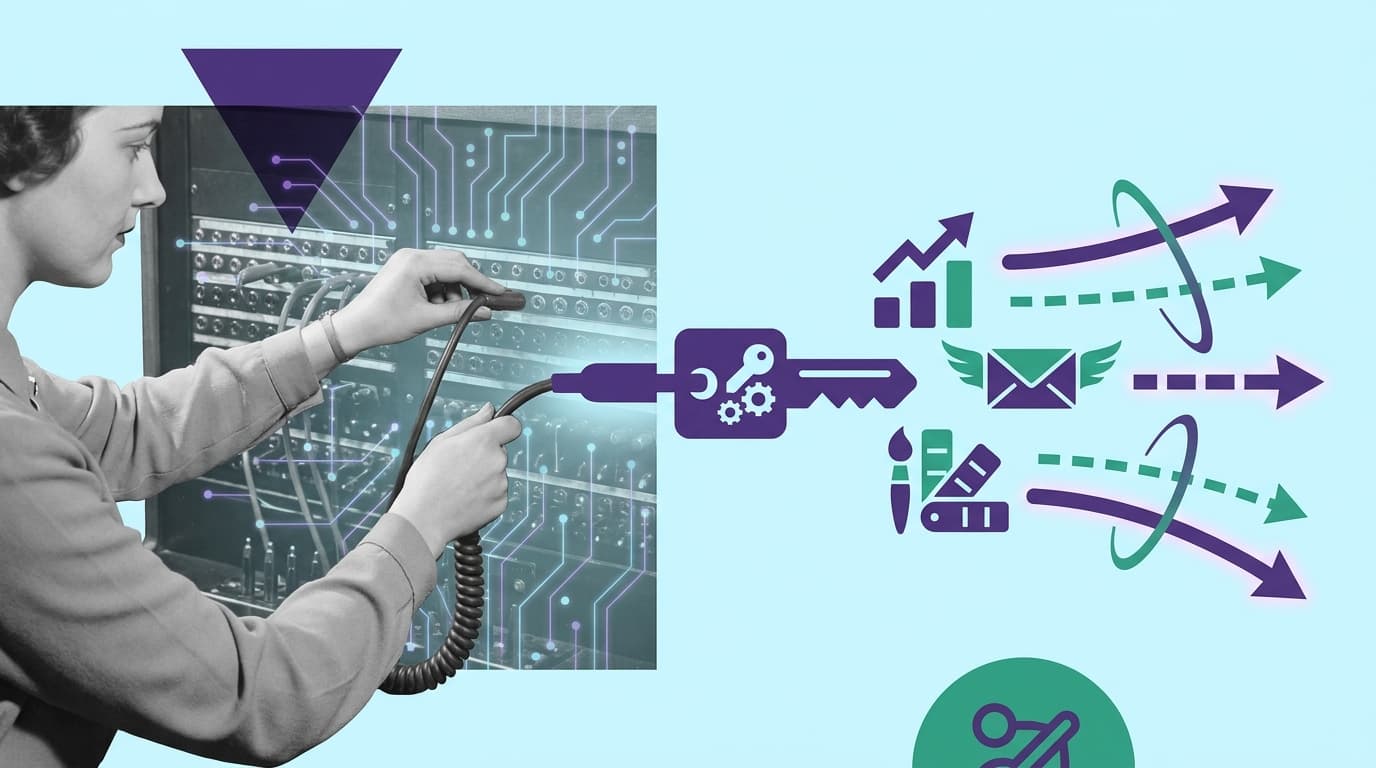
Then there's execution, which is the part the industry has been allergic to. A director who can only recommend is a consultant. Maia ships work. She designs creatives, proposes concepts, scales ad variations, and writes headlines in your brand voice. This is the shift the industry trade press has been documenting all year: agentic AI moving into the centre of the marketing stack, taking responsibility for entire workflows rather than sitting beside them. The truth is that most of those agents still execute one task. Maia executes the campaign.
What this means for CMOs and founders
The clearest demonstration of the whole stack working together is Campaign Autopilot. You give Maia a campaign type. She produces the brief, the concept, the hero copy, the hero image, the key visuals, the asset pack, and the tactical outputs across email, social, search, and display—in under ten minutes.
When she's done, she tells you on whatever channel you prefer: a Slack-style in-app notification, an email with the full tactic table, a WhatsApp message if you're mobile, or a voice update if you happen to be in a meeting. The first time I watched it run start-to-finish on a real client account, I understood why every previous attempt at "agentic marketing" had felt like a magic trick. They were generating outputs. Maia was running a campaign.
The honest counterargument is that "director" implies taste, accountability, and strategic instinct—things software can't truly own. That's fair. We're not claiming Maia has taste in the way a brilliant CMO does. What we're claiming is narrower and, I think, defensible: the scope of work an account director executes—remembering, deciding, briefing, building, shipping, measuring—is now executable by a single AI system for the first time. The judgment layer above that still belongs to humans. It probably always will.
For a CMO, the implication isn't that you fire your team. It's that the work your team spends 60 to 70% of its time on—the coordination, the asset production, the campaign assembly, the cross-tool stitching—stops being the bottleneck. Gartner's 2025 CMO Spend Survey found marketing budgets stuck at 7.7% of company revenue for a second straight year while expectations kept climbing, with CMOs explicitly prioritizing productivity gains to squeeze more value from static budgets.
Something has to give, and it isn't going to be ambition. For a founder or small business owner, the implication is even more direct: you now have access to a marketing function you previously couldn't afford.
We spent the beta calling Maia a co-pilot because it felt like the safer word. At launch, we're done hedging. The job has a name. So does the AI now doing it.

Chrissy has spent two decades inside the marketing process Protaigé is transforming. She directed global campaigns for Mercedes-Benz, Coca-Cola, and Johnson & Johnson, then founded two companies that scaled to multi-million dollar outcomes: Quickcut, which transformed Singapore's print advertising delivery, and PaperplaneCo, a B2B creative agency serving Adobe and SAP for 15 years. She's seen firsthand how marketing intelligence gets trapped in agency relationships, scattered documents, and people's heads - and watched it walk out the door every time someone left.
CONTINUE READING
Campaign Director vs Campaign Manager: Why Your Job Title Doesn't Match Your Calendar
Your title says you direct campaigns. Your calendar says you assemble them. The strategic half of the role went missing somewhere in between.
 Wawa Gilewski
Stuck in Marketing No Man's Land: The Mid-Market Agency Gap
There's a chasm between DIY tools and $500k retainers, with a lot of very tired marketers in it.
Wawa Gilewski
The Hidden Tax Your Marketing Stack Is Charging You
Nearly half of marketers lose a quarter of the week to admin and tool-hopping. That bill never arrives on an invoice.
Wawa Gilewski