Why Brand Guidelines Fail in Practice (and What to Do About It)
Static PDFs cannot govern AI-era content at scale. See why brand guidelines fail in practice and how to turn brand into a self-enforcing system.


Key Takeaways
- 62% of marketers have seen content demand grow at least fivefold in two years, and 56% now have teams outside creative and design producing customer-facing content
- Brand drift is a system problem, not a discipline problem — guidelines fail because they're asynchronous, written for the wrong reader, and have no enforcement loop
- The fix is treating brand as infrastructure: a living, queryable system embedded in production tools, not a 90-page PDF
- Make the on-brand version the path of least resistance, so getting it wrong is harder than getting it right
- The brand team's job shifts from policing output to curating the system that produces it
Every company has them. The 90-page PDF in SharePoint. The Figma file with the official logos. The Notion page with the tone-of-voice principles, three sample headlines, and a dos-and-don'ts table. Onboarding decks reference them. Vendor briefs link to them. And yet, within a few months, the homepage hero, the LinkedIn carousel, the sales deck, and the trade-show banner all look like they came from four different companies.
Brand drift isn't new. But is it just something marketers have to live with, or is there actually something we can do about it? Let's find out.
Why brand drift feels like it's getting worse
Look at what marketing teams are actually doing today versus a few years ago, before generative AI showed up, and a few things stand out:
-
Demand for content has exploded
A global Adobe survey of more than 1,600 marketers found 62% have seen content demand grow at least fivefold in the past two years, and 71% expect another fivefold increase by 2027. 70% of marketers now produce more than 1,000 content assets a year, and roughly a quarter produce between 10,000 and 100,000.
-
More people across functions are producing content
56% of marketers say teams outside creative and design now produce customer-facing content, and that shift has made brand consistency materially harder, according to an IDC survey of more than 2,000 marketing and creative professionals. Many of the people producing your content today were not in the room when the guidelines were written.
-
Brand governance is more of a challenge than ever
61% of marketers say managing global-to-local brand governance is a real challenge, according to Frontify. The day-to-day cost shows up in small, repeated friction — roughly 15 minutes lost every time someone hunts down the current guidelines. Multiply that across a large team and you're funding a steady leak of productivity, plus a stream of off-brand work whenever people give up and improvise.
Stack these three trends together and the picture gets uncomfortable. Output has changed. Who produces it has changed. But the brand guide holding it together hasn't kept pace with either. It worked when 10 people produced 50 assets a month. It cannot govern hundreds of people — half of them outside marketing, many not human — shipping thousands of assets a week. That gap is the real source of the drift.

Why static brand guides don't work
Brand guides usually get created at the same time as the brand identity. They describe what the brand is, but they don't say much about how to actually use it day to day, or how to enforce it. Treat the brand as a living system instead of a fixed description, and the problems with a PDF becomes obvious:
-
The documentation is asynchronous, and the work is synchronous. Guidelines describe principles in the abstract, but production happens against a deadline, with a specific brief, in a specific tool, at a specific moment. By the time somebody has finished interpreting a guideline, someone else on the team have already made eight decisions the guideline didn't address.
-
Guidelines optimise for the wrong reader. They are written for the brand team, by the brand team, with the level of nuance the brand team finds useful. The people who actually shape day-to-day output — performance marketers, agency contractors, regional teams, freelancers, sales enablement — need decisions, not nuance. They need to know whether this specific thing they are about to publish meets the bar. A guideline can answer that question only by being read, interpreted, and applied by a human, every single time. And that human capacity does not scale.
-
Guidelines have no enforcement loop. There's no system that says no when somebody picks the wrong shade of brand green for an off-platform ad. So drift accumulates slowly, asset by asset, until somebody runs a brand audit and discovers that 40% of regional partner output is off-brand. At that point, the brand team is auditing the symptom, not the system.
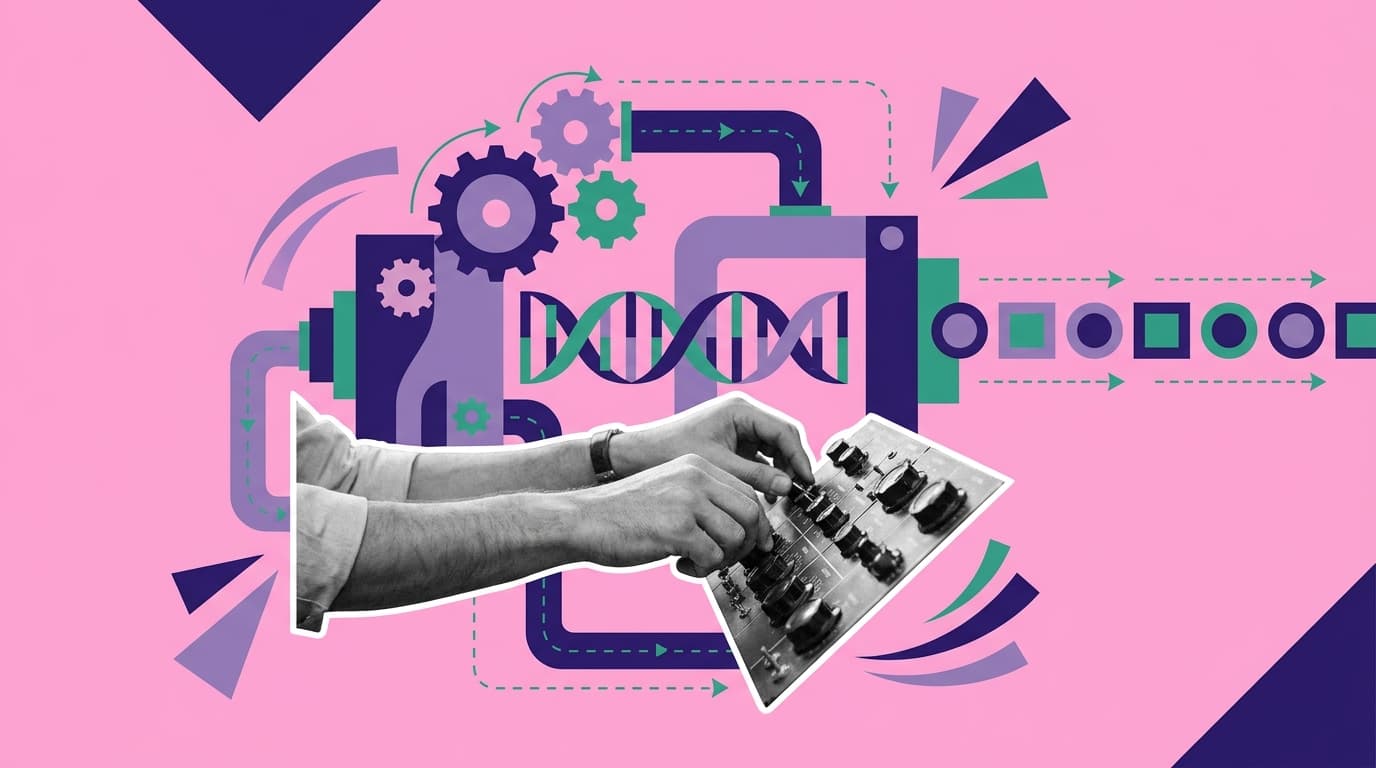
If the guideline-as-document model is the problem, the answer isn't more guidelines. It's converting brand into something that behaves more like infrastructure than literature. That means treating brand as a living, queryable system rather than a static reference, where voice, tone, persona, product, audience, and visual identity sit in one place any contributor can interact with at the moment of creation. Not later, not as a check, but as the source the work is built from.
It also means baking the guardrails into the production tools themselves, so the on-brand version is the path of least resistance and the wrong version is harder to make than the right one. And the system has to get smarter, not heavier, with every campaign, asset, and decision refining its understanding of what on-brand looks like for this organisation, in this category, for this audience.
Self-enforcing, not self-policing
When an organisation makes the leap to a self-enforcing brand system, it changes who does what. The brand team stops policing output and starts curating the system that shapes it, tuning the parameters that make the next thousand assets land on-brand on the first try. Output volume goes up, approval cycles shrink, and last-minute rework to ensure consistency disappears. This is roughly the thinking behind Protaigé's Brand DNA — a living system that auto-applies your voice, visuals, and positioning to every output. Brand becomes operating leverage rather than overhead.
So skip the debate about updating the brand guideline. Audit instead. Pull the last 50 published assets across web, social, paid, sales enablement, and partner channels, then ask three people outside the brand team to score each on a 0–10 scale for brand fit. If the average lands at 6.5 or below, the document isn't the leverage point. The system around it is.

Wawa has a decade of consulting and process optimisation experience - from Deloitte CEE strategy to in-house process improvement roles, to founding one of Poland's first virtual assistance networks, to running his own market intelligence consultancy across 14+ industries including financial services, transport, telecom, and healthcare. He's mapped go-to-market workflows, optimised time-to-market processes, and aligned sales operations with strategic goals - the same systematic thinking now applied to marketing process transformation.
CONTINUE READING

Canva, Agency, or Sketch Studio? How to Choose Where Your Marketing Creative Gets Made
Templates you can ship this afternoon, or agency work that comes back after the second rebrief. That isn't the whole menu.
 Wawa Gilewski
Stuck in Marketing No Man's Land: The Mid-Market Agency Gap
There's a chasm between DIY tools and $500k retainers, with a lot of very tired marketers in it.
Wawa Gilewski
Brand Voice Gap: Why Your AI Content Sounds Like Everyone Else's
AI writes generic content because you haven't given it your brand. Fix the input, and the output fixes itself.
Wawa Gilewski